
Read the Main Gooding County Deed Types
A Gooding County deed records a stated conveyance between named parties, and the words on the page are what count. Read the deed type, legal description, execution date, recording date, and instrument references together rather than one at a time. Each detail supports the others.
| Deed Type | What It Does | Common Use |
|---|---|---|
| Warranty deed | Conveys an interest with stated warranties | Ordinary sale or transfer |
| Quitclaim deed | Conveys whatever interest the grantor holds | Interest cleanup or related-party transfer |
| Personal representative deed | Conveys through estate authority | Probate-connected transfer |
| Trustee deed | Conveys under stated trust authority | Trust or deed-of-trust context |
| Tax deed | Records a tax-process conveyance | Completed county tax sale |
The recorder's collection holds more than deeds. Mortgages, deeds of trust, assignments, reconveyances, releases, and liens sit in the same deed records but do different work. A deed transfers ownership; an encumbrance document may burden or release an interest without conveying anything.
Use the Gooding County Grantor-Grantee Route
Gooding County offers no online grantor-grantee search. Start instead with the county GIS, pulling the parcel number and deed references shown there. Then ask the Recorder to locate the matching index entry or instrument.
- Obtain the current vesting instrument with the present owner as grantee.
- Read the grantor, deed type, recording date, and exact land description.
- Find the earlier instrument in which that grantor acquired the same land.
- Repeat through the office index or deed books, documenting every source.
- Grantor
- The party conveying the stated interest.
- Grantee
- The party receiving it.
- Chain of title
- The linked sequence of instruments affecting the land.
- Book/page or instrument number
- The citation used to retrieve a recorded item.
Get a Copy of a Gooding County Deed
The Gooding County Clerk, Auditor & Recorder keeps the deed records at 624 Main Street, Gooding. Mail goes to PO Box 417. The office answers at 208-934-4841. Ask which route fits. Counter inspection, an in-office index, mail fulfillment, a plain copy, and certification each serve a different purpose. The county's recording-fee guidance lists instrument examples. $15 covers many deed types and releases. $45 covers mortgages, deeds of trust, and assignments. Copy charges are not the same as filing fees. Request a current copy estimate instead of assuming the recording amount applies.
Recorded, not guaranteed. Gooding County deed records show instruments accepted for recording. They do not establish clear title, survey a boundary, or rule out every unrecorded interest.
Give the Gooding County Recorder Retrieval Fields
| Names | Exact grantor, grantee, trust, estate, or entity spelling |
|---|---|
| Land key | Parcel number plus complete legal description |
| Document clue | Deed type and GIS deed-reference value |
| Time window | Approximate execution or recording dates |
| Delivery | Inspection, plain copy, or certified copy |
Give staff these fields so they can search an existing index without drafting a title report. If the parcel was split or merged, include both the current and parent description clues.
Extend Gooding County Deeds into Historic Images
The FamilySearch Gooding County Records, 1879–1962 collection publishes courthouse-sourced images. Land, probate, and related groups there can reveal an earlier deed or an estate bridge. The collection dates do not promise full indexing. Not every instrument is indexed by name or viewable from home. Browse the relevant image group where needed. Cite the image and volume, and confirm with the custodian when current legal effect matters.
Note: Gooding County's 1913 creation makes Lincoln County and earlier jurisdiction sources relevant to some pre-county chains.
Match the Gooding County Legal Description
Street addresses change, and rural parcels may lack a situs. Match the lot, block, subdivision, plat, section, township, range, and metes-and-bounds text as they apply. The legal description, not a shared surname, proves that consecutive instruments concern the same land. Use the parcel popup's abbreviated description as a finding aid. Then read the full wording in the deed itself. For a split, merge, or minor land division, request the parent deed. Also request the recorded plat or survey that explains the new geometry.
See Gooding County's Document Access Starting Point
The official Recorder office page is the documented route for present deed access:
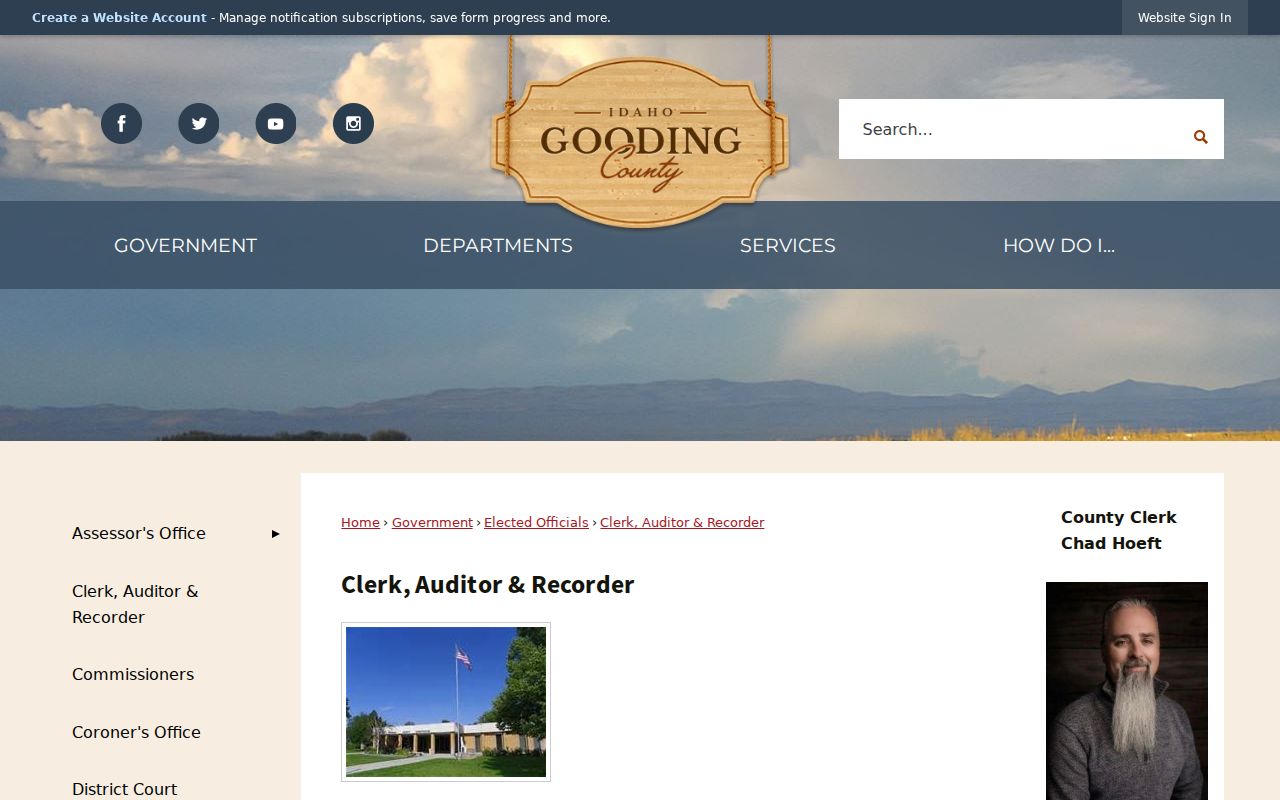
The county's contact page shows the office's public channels plainly. It offers no browser-based grantor-grantee index, so document requests go through the listed routes.
Connect Probate and Gooding County Deed Records
A personal representative's deed, a distribution order, or a probate case can explain a gap between named owners. Search the Idaho iCourt Public Portal for a public case lead, then retrieve the recorded deed and any accessible court document from its custodian. Sealed and protected material stays restricted. Keep the court case number and the recorder citation separate. The case explains authority; the recorded instrument supplies the land-record link.
Use Every Gooding County Deed Access Channel
Each channel plays its part. The GIS supplies parcel and deed-reference clues. The Recorder holds current indexes and instruments at the counter, by phone, and by mail. FamilySearch carries part of the historical image trail. The Gooding Public Library and Historical Society can help normalize old names and addresses. A written request under Idaho Public Records Law may seek inspection or existing copies. Idaho guidance generally allows three working days for a response. Alternatively, the office may send written notice that up to ten working days are needed. Ask for a cost estimate. Do not ask the office to build a new chain of title.
Read Instruments Filed Beside Gooding County Deeds
A deed search should note companion filings without mistaking them for transfers. The recorder may hold mortgages, deeds of trust, assignments, reconveyances, releases, satisfactions, powers of attorney, plats, and lien instruments. These sit under the same names or legal description. Their sequence can explain financing, a released claim, authority to sign, or a parcel change. None of that alters the rule. The deed's operative language and the full record chain must stand on their own terms.
| Recorded item | Question it helps answer | What it does not prove alone |
|---|---|---|
| Deed of trust or mortgage | What secured instrument was recorded? | Who presently owns the parcel |
| Assignment | Was a recorded interest assigned? | That the underlying obligation remains due |
| Reconveyance or release | Was a named recorded claim released? | That every possible claim is cleared |
| Plat or survey | How was land described or divided? | A final field boundary without survey work |
Ask the Recorder to search exact party-name variants. The office can also check the land description within a set date range. If an entity appears, the Idaho Secretary of State Business Search can clarify its filed name. That business filing helps with normalization. It is not part of the county title index, though, and proves no conveyance.
Audit Each Gooding County Deed Citation
Every deed you pull deserves its own careful citation. Record the instrument or book/page reference, the grantor, the grantee, and the deed type. Add the execution date, the recording date, the legal description, and any consideration language that is public. Also add the return address and references to prior instruments. Transcribe names and numbers first. Summarize only after the transcription is done. That discipline builds a reproducible trail and exposes any missing link in the chain.
Next, test the land description against the current parcel and the deed just before it. A matching surname attached to different land proves nothing about the chain. A changed parcel number with a matching parent description might prove everything. Estate files, trust transfers, and minor land divisions often demand this closer comparison. Only then does the record make sense.
Gooding County publishes no dedicated property-fraud alert page. Do not invent a subscription, and treat unsolicited payment instructions as a warning sign. Verify deed and fee directions through the Recorder's published office page and telephone number. If a suspicious filing touches a legal interest, preserve the official citation. Then get qualified legal guidance.