
Build a Gooding County Deed Chain Backward
Start at the Gooding County GIS viewer. Save the legal description. Deed-reference clues from the map, together with the newest recorded deed, point straight to the prior owner of record.
| Chain step | Grantor to grantee | Document detail | Control check |
|---|---|---|---|
| Newest transfer | Seller to current grantee | Type and date as recorded | Parcel and legal description |
| Grantor's acquisition | Earlier seller to later grantor | Book/page or instrument | Same land, not merely same name |
| Next earlier link | Prior seller to prior buyer | Source and image noted | Gap or inference marked |
Recent links live in the Recorder's deed records, while older ones usually require historical images and the original deed books. Directories and newspapers can pin down a name, but only a recorded conveyance proves the chain.
Walk the Gooding County Index in Reverse
Gooding County publishes no online grantor-grantee index. Instead, work through the Gooding County Clerk, Auditor & Recorder, supplying the current owner of record, parcel number, legal description, deed references, and the date range you need.
- Read the newest deed and capture grantor, grantee, date, type, and land description.
- Find the earlier deed in which that grantor appeared as grantee.
- Compare lot/block/subdivision or section-township-range text before accepting the link.
- Repeat, preserving a source reference and unresolved gaps at every step.
- Grantor
- The party conveying an interest.
- Grantee
- The party receiving the stated interest.
- Chain of title
- The linked sequence of instruments affecting the land.
- Reverse index
- The route organized through grantor names.
How Far Gooding County Ownership Research Reaches
The FamilySearch Gooding County Records collection digitizes courthouse images dated 1879 through 1962, covering land and probate record groups. Those years describe collection coverage only. They do not promise a complete chain for every parcel.
Historical coverage has edges. No public current deed index was found, while older images reach through 1962. Use courthouse indexes and deed books for gaps; silence is not proof that no transfer occurred.
The 1913 Gooding County Boundary Reset
Gooding County dates only to 1913. It was carved from Lincoln County that year. Any deed, probate matter, or family name from before then may sit in Lincoln County records or in territorial and federal land sources. Formation is a clue, not proof. It does not confirm that every predecessor index moved into the current office, and the handoff matters most for rural land described by section, township, and range rather than modern streets.
Follow Gooding County Land When Names Change
Names change. Initials, spelling variants, marriages, estate captions, trusts, and business names can all disguise the same party, so the legal description, not the name, anchors the search. Keep lot, block, and plat references. Rural land uses section, township, and range. Because a modern parcel number may not predate a split or merge, compare the parent description and complete metes-and-bounds text rather than forcing one ID onto every historical row.
A warranty deed carries stated warranties. A quitclaim deed conveys whatever interest the grantor held, and neither label alone proves clear title.
Turn Historic Gooding County Clues into Requests
Old clues help. The Gooding Public Library research resources include cemetery records, yearbooks, newspapers, and local histories. Search exact and variant spellings. Initials, estate suffixes, and trust captions help too. Historical society, state, and university directories also connect an old name to a date and place. Cite the source. Use it to narrow a recorder or probate request. Never promote that clue into a current-owner statement.
Note: A directory documents association with an address, not a transfer of title.
The Gooding County Recorder Is the Chain Hub
The official Recorder page shows the current access route:
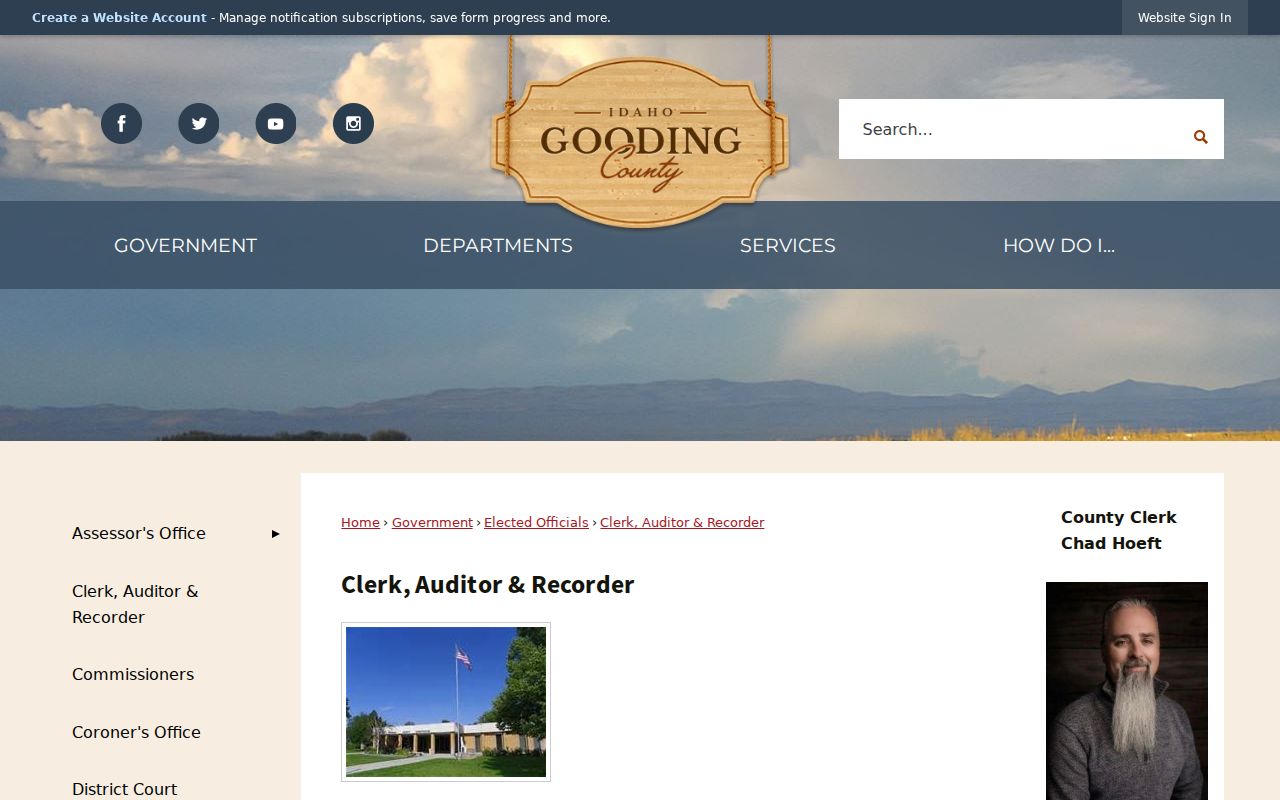
No online index exists. Call 208-934-4841, use the counter at 624 Main Street, or mail a narrow chain request to PO Box 417.
Probate Can Bridge a Gooding County Chain Gap
A chain sometimes skips a name. A personal representative's deed, distribution order, decree, or other estate-named record can explain why one person never appears in consecutive conveyances. Check the Idaho iCourt Public Portal first. Then request the case or the recorded instrument from its custodian. Protected cases stay restricted. Keep court references and deed references in separate columns, because the proceeding explains the transfer while the recorded instrument supplies the chain link.
Keep a Reproducible Gooding County Owner Timeline
Log every detail. For each prior owner, record the search date, exact name, party role, instrument type, execution and recording dates, book and page or instrument number, legal description, and image or office source. Mark inferred links clearly. Supporting records can confirm them later. A focused request under Idaho Public Records Law may seek inspection or existing copies. Ask for a cost estimate before a broad pull, and never ask the custodian to create a new ownership history.
Use history lawfully. Former-owner research supports house history, estate work, and purchase diligence. Never use it to track, harass, threaten, or harm anyone.
Use Townsite History to Reconnect Former Owners
Old sources rarely speak in modern addresses. A townsite block, an avenue, a business name, or a family name can identify an owner that today's parcel search misses. Gooding began as Toponis. The railroad stop was tied to cherries before its 1907 name change and 1910 incorporation. Wendell repeated the pattern. Its 1907 townsite and 1909 incorporation explain why early block and avenue references predate modern GIS address conventions.
Treat those years as search pivots. Look for both place names, variant street descriptions, subdivision or townsite names, and the legal description carried in the contemporary deed. The narrative narrows the field. The deed description verifies it. Cite every dated clue precisely. For a directory or newspaper hit, record the publication title, date, page, name spelling, and address.
The Idaho State Historical Society and the University of Idaho hold Gooding-area directory and newspaper runs, and the Gooding Public Library keeps local-history resources. Then bring the dated clue to the Recorder, or use it to locate the correct courthouse image group.
Separate clue from proof. A person could have lived or operated a business at an address without owning it. Add a former owner to the chain only when a deed or other controlling transfer record supports the link.